
Key facts: Smoke odor that won't go away
- Lingering smoke odor almost always comes from residue still trapped in porous materials, hidden spaces or ductwork.
- Odor often returns on hot or humid days because heat and moisture release compounds held in materials.
- EPA warns that ozone generators can harm the lungs and are not effective at safe levels for most indoor pollutants [1].
- Painting over smoke-stained surfaces without cleaning and a sealing primer rarely stops the smell.
Short answer
Why smoke smell lingers: the short answer
Smoke odor that won't go away is almost always coming from residue that has not been removed. Smoke particles and gases settle into porous materials such as insulation, carpet pad, upholstery, drywall paper and unfinished wood, and they creep into hidden spaces such as wall cavities, attics and ductwork. Those reservoirs keep releasing odor, especially when the house warms up or the air gets humid.
Fragrances and short-term air treatments only cover the smell. Lasting results come from finding the source, cleaning or removing it, and then sealing or deodorizing what is left. See odor removal for how professionals approach it.
At a glance
Where the smell comes from and what to do
| When you notice it | Likely source | What to do |
|---|---|---|
| Every time the HVAC runs | Residue in ducts, coil or blower | Have the system inspected and cleaned; replace filter |
| On hot afternoons upstairs | Attic insulation or framing | Inspect attic; replace sooty insulation |
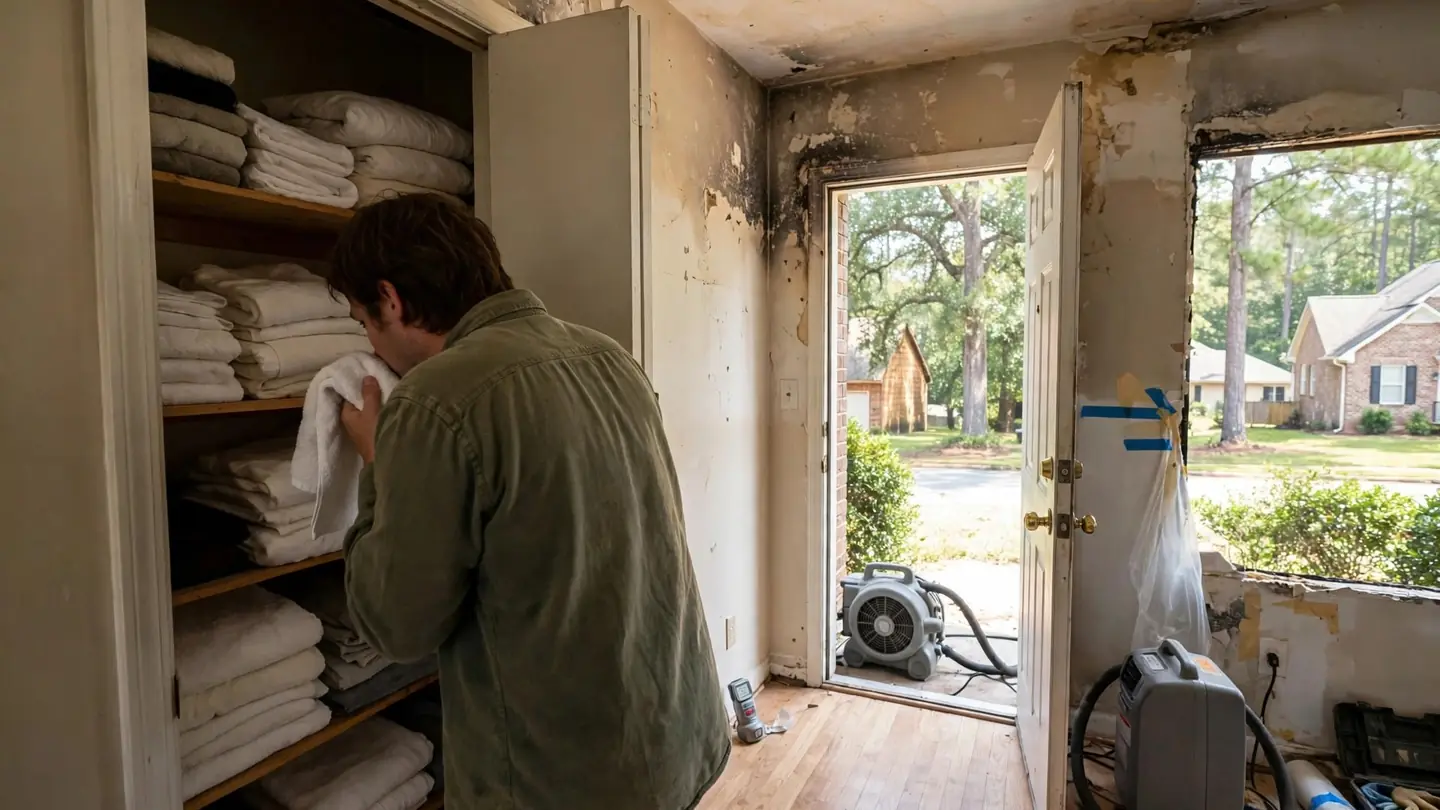
| Inside closets and drawers | Residue on stored items and closet surfaces | Clean contents; clean and seal closet |
| Near outlets and switches | Smoke inside wall cavities | Inspect cavities; treat and seal |
| On humid or rainy days | Porous materials releasing odor | Find and remove remaining porous sources |
| After new paint | Paint applied without sealing | Clean and use a smoke-sealing primer |
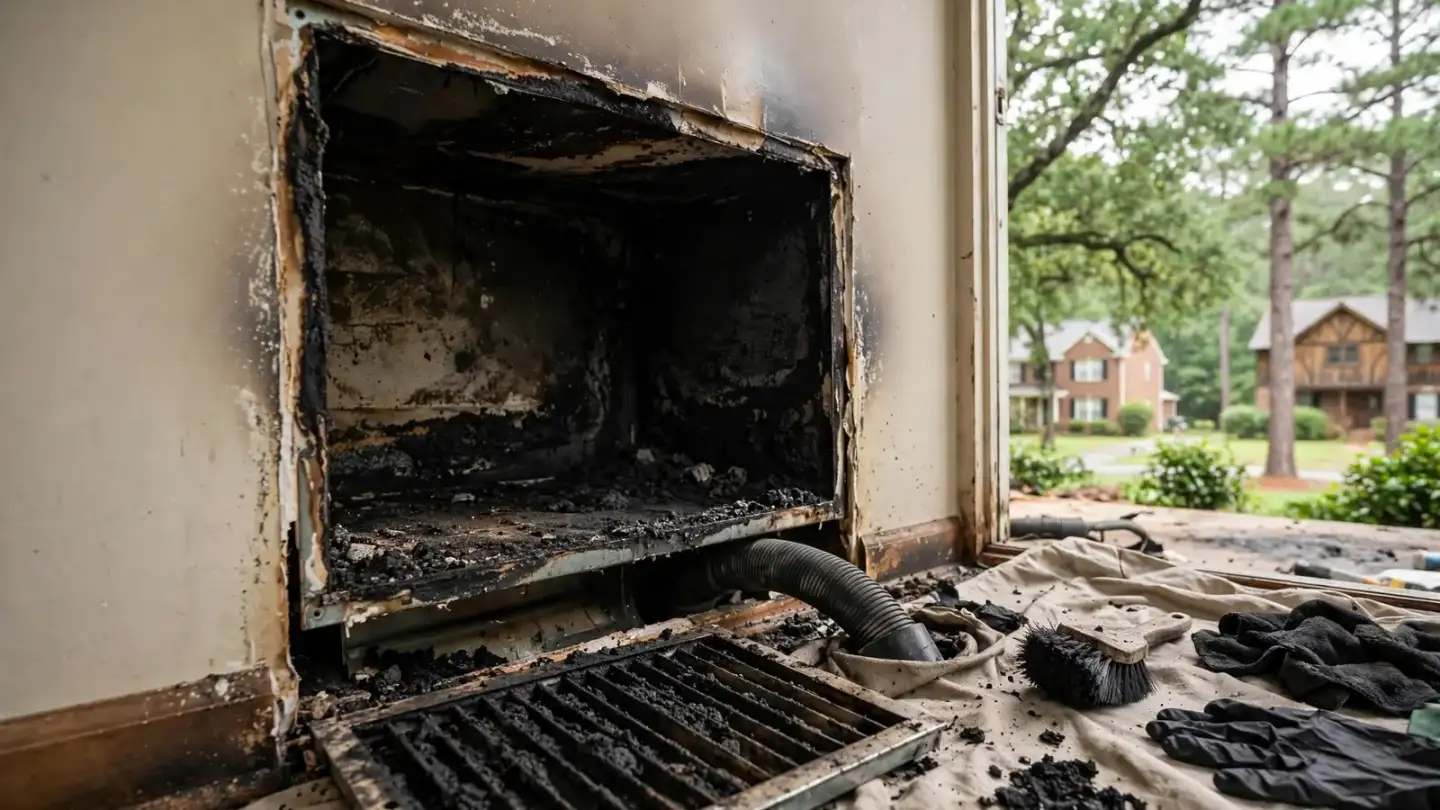
Ductwork is a common hiding place for smoke odor
Safe checks
Simple checks you can do yourself
- Leave the house for a few hours, then notice your first impression when you return.
- Open closets, cabinets and drawers one at a time and smell inside.
- Pull the HVAC filter and look at it; a dark gray filter after a short time suggests residue in the ducts.
- Smell near supply registers when the system starts.
- Check the attic hatch area and the edges of the attic if you can do so safely.
- Notice whether the smell is stronger on warm or humid days.
HVAC
The air system: the most common culprit
If the heating or cooling system ran during or after the fire, it likely pulled smoke into the return, coated the coil and blower and pushed residue into the ducts. Every time the system starts, it can release a puff of odor. Replacing the filter helps a little, but residue on the coil and inside the ducts stays until it is cleaned.
A thorough fix involves cleaning the blower and coil, cleaning the ducts that carried smoke, replacing damaged flexible duct and installing a new filter. Ask whoever cleans the system to show you before-and-after photos.
Hidden spaces
Attics, wall cavities and crawlspaces
Smoke rises, so the attic above a fire is one of the most common odor reservoirs. Insulation acts like a giant filter and is very hard to deodorize in place; replacing it is usually the reliable fix. Wall cavities, especially in older homes without fire blocking, carry smoke between floors and keep releasing odor through outlets and switch boxes.
Crawlspaces add another source: firefighting water that drained through the floor can leave wet, sooty insulation that adds a musty note to the smoke smell. Drying and removing it often clears up odor in the rooms above.
How a pro diagnoses it
How a restoration contractor tracks down odor
- 1
Smell-map the house
Walk each room with the house closed up and the air system running, noting where odor is strongest.
- 2
Inspect hidden spaces
Check the attic, crawlspace, closets and HVAC components.
- 3
Test materials
Wipe tests and odor checks on surfaces show where residue remains.
- 4
Remove sources
Take out materials that cannot be cleaned, such as sooty insulation and carpet pad.
- 5
Clean, seal and deodorize
Clean surfaces, seal framing and drywall, and use deodorization methods suited to the home.
Ozone
A note on ozone machines
Ozone machines are often sold as a cure for smoke odor. EPA explains that ozone is a lung irritant and that, at concentrations safe for people, it does little to remove most indoor pollutants [1]. Professionals who use high-output ozone do so in empty buildings with strict safety steps, and only after cleaning. Running a small ozone machine in an occupied home is not a safe or effective substitute for finding the source.
Repair or replace
When to clean and when to replace
Hard, sealed surfaces almost always clean well. Porous materials are the problem. Insulation, carpet pad, mattresses and some upholstered furniture are often more reliably replaced than cleaned. Drywall and framing that still hold odor after cleaning can be sealed with a primer made for smoke. A good rule: if an item still smells after it has been cleaned and left closed in a bag for a day, the residue is still inside.
Prevention
Keeping the smell from coming back
- Replace HVAC filters after cleaning and again a few weeks later.
- Keep humidity in a comfortable range with the air conditioning or a dehumidifier.
- Return cleaned items to the house only after the house itself is clean.
- Ask the contractor to recheck after the house has been closed up on a warm day.
FAQ
Lingering smoke smell: questions
How long should smoke smell last after a fire?
With proper source removal, cleaning and deodorization, most homes return to a normal smell. If odor lasts weeks after cleanup, some source has been missed.
Why does the smell come back when it's hot?
Heat and humidity release odor compounds trapped in porous materials. A smell that returns on warm days points to residue still inside insulation, framing, carpet pad or ducts.
Will an air purifier fix it?
A HEPA and activated carbon purifier helps reduce odor in the air, but it cannot remove residue from surfaces or ducts. Use it alongside cleaning.
Can I paint over the smell?
Only after cleaning, and with a primer designed to seal smoke odor. Ordinary paint lets odor bleed through.
Is it unhealthy to live with lingering smoke smell?
Smoke residue includes fine particles, and EPA links fine particle exposure to breathing and heart problems. [3] If the smell is strong or someone has symptoms, have the source found and removed.
Does baking soda or vinegar get rid of smoke smell?
They can soften light odor in small items or a closet for a while, but they cannot reach residue inside walls, insulation or ducts. Treat them as a stopgap while the source is found and removed.