
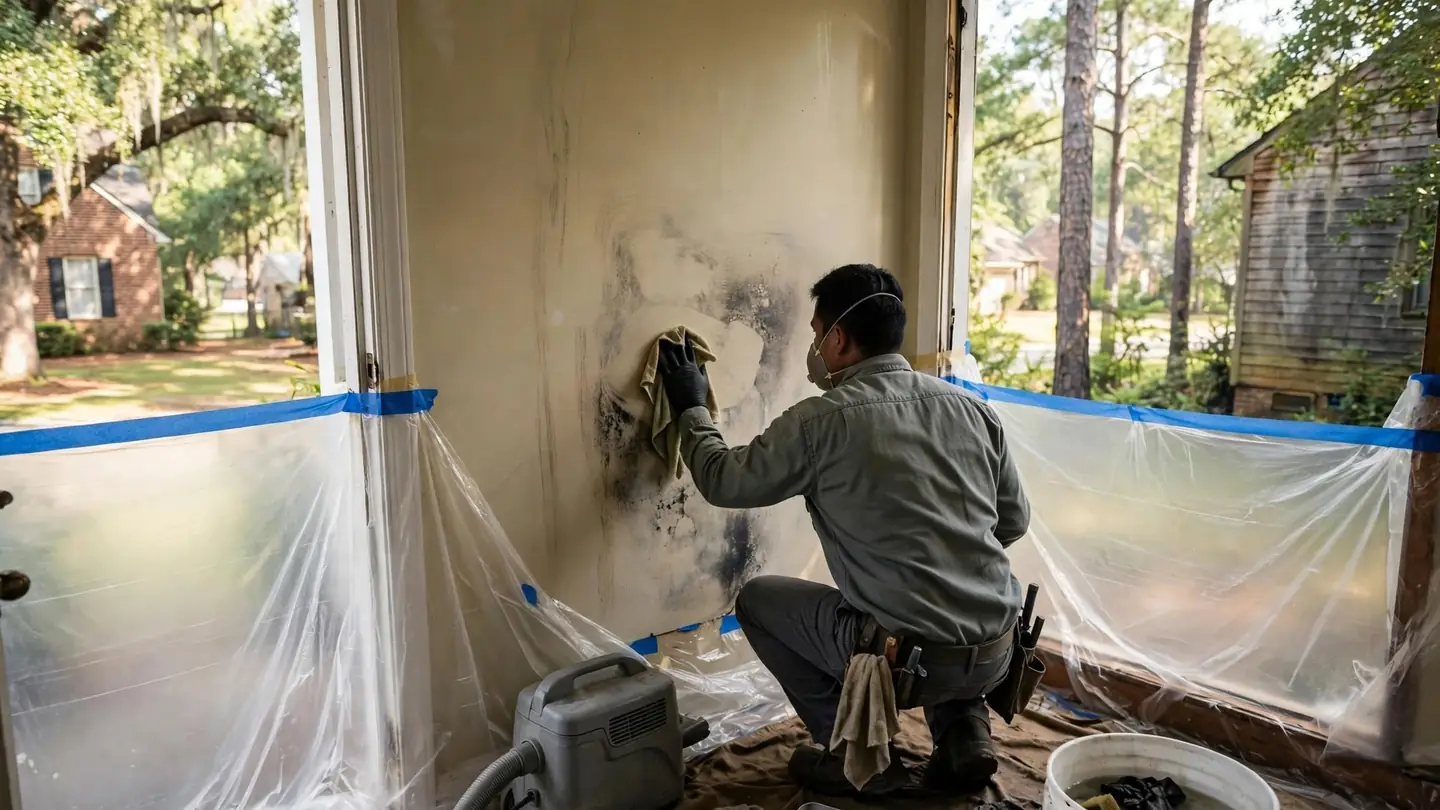
Key facts: Smoke Damage Cleanup
- Smoke residue can spread through a whole house even when the fire stayed in one room, because hot gases rise and follow air currents through doorways, returns and attic openings [1].
- The American Red Cross advises against reentering a fire-damaged home until the fire department says it is safe [2].
- Soot and smoke particles are fine particulate matter, which EPA links to breathing and heart problems [3].
- Moisture left from firefighting can lead to mold growth if materials are not dried within about 24 to 48 hours [4].
How smoke behaves
Where smoke goes once a fire starts
A house fire produces heat, flame and a dense cloud of gases and particles. The flames usually stay in one area, but the smoke does not. Hot gas rises, pools against ceilings, then pushes sideways and downward into every room it can reach. It follows the path of least resistance: open doorways, stairwells, return air grilles, recessed light housings, gaps around pipes and the attic hatch. By the time firefighters knock down a small kitchen fire, the hallway, the bedrooms and the closets may already carry a thin layer of residue [1].
That spread is why homeowners are often surprised by the scale of a smoke job. A pan fire that scorched one cabinet can leave a gray film on a bedroom ceiling forty feet away, a dark line where air leaked past the top of a closed door, and a sour smell inside the dresser drawers. Cooler surfaces attract more residue, so exterior walls, window glass, metal fixtures and the areas behind furniture tend to show it first.
Smoke also travels through hidden spaces. Wall cavities, floor joist bays, ductwork and the attic all act as channels. If the central heating or cooling system was running when the fire started, the blower may have pulled smoke into the return and pushed it out of every supply register in the house. That one detail changes the scope of the cleanup, so it is worth telling the contractor on the call whether the system was on.
Warning signs
Signs that smoke reached more than one room
These clues help you judge how far the residue traveled before anyone starts cleaning.
A gray or yellow film on light switches
Run a clean white tissue across a switch plate or a door frame in a room away from the fire. Any smear means residue settled there too.
Read moreDark lines around doors and vents
Smoke pushed through the gap above a closed door or out of a supply register leaves a sharp shadow that outlines the air path.
A smell that comes back on warm days
Odor that fades and then returns when the house heats up usually means residue sits in porous materials or inside the ductwork.
Read moreDiscolored plastics and appliance fronts
Light-colored plastics can yellow quickly when acidic residue sits on them. The longer it stays, the harder it is to reverse.
Pitting on chrome or brass
Fixtures in a bathroom near the fire may tarnish or pit within days if the film is not removed.
Stained ceilings in closets
Closets act as dead-air pockets. Residue often collects on the closet ceiling and the clothes stored inside.
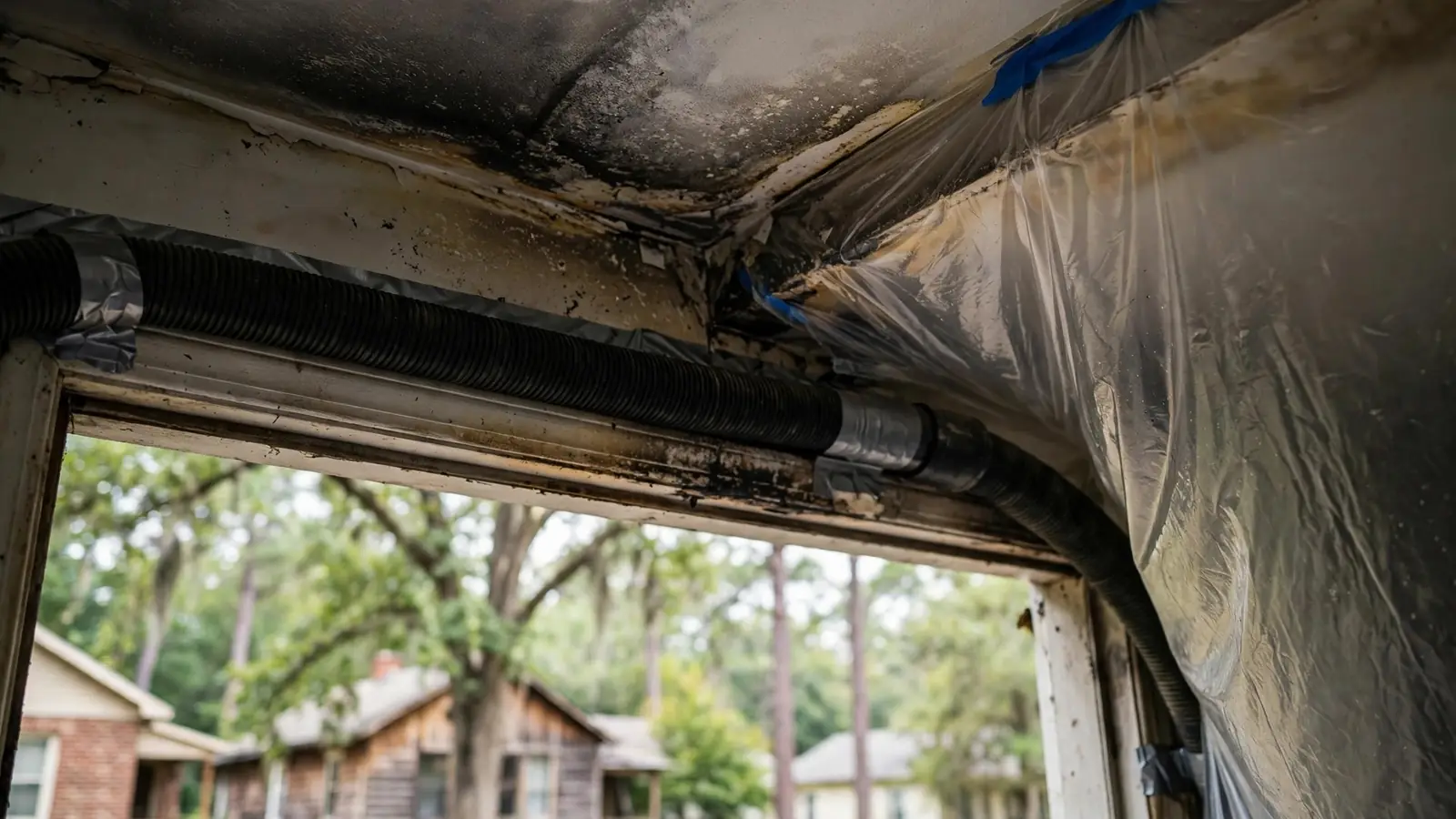
Smoke often leaves its heaviest marks along ceiling lines and above do
Types of residue
Why the type of smoke changes the cleanup
Not all smoke leaves the same kind of mess. What burned, how hot it burned and how much oxygen the fire had all shape the residue. A fast, hot fire in paper or wood tends to leave a dry, powdery soot that smears if you wipe it the wrong way. A slow, smoldering fire with low oxygen leaves a sticky, darker film with a strong smell. Burned plastics, foam cushions and synthetic carpet create a greasy, black residue that clings tightly.
Kitchen fires add another type. When cooking oil, meat or other proteins burn, they can leave an almost invisible yellowish film with an intense odor that seems out of proportion to the visible damage. Many homeowners think a kitchen protein fire caused little harm because the walls look clean, then find that the smell lingers for weeks.
This matters because the wrong cleaning method can make things worse. Wet wiping dry soot can drive it into paint and drywall paper. Strong solvents can lift finish from cabinets. A good restoration contractor tests a small area first, identifies the residue type and chooses the cleaning method to match. When you call, describe what burned and whether the residue feels powdery, oily or sticky.
Residue guide
Common smoke residues in a house fire
Identifying the residue first keeps the cleanup from spreading it further.
| Residue | Typical source | How it feels | Cleaning approach |
|---|---|---|---|
| Dry smoke soot | Fast, hot fire in wood or paper | Powdery, smears when wiped | Dry sponge or vacuuming before any wet cleaning |
| Wet smoke residue | Smoldering fire, low oxygen, plastics | Sticky, smeary, strong smell | Detergent cleaning, often repeated; some porous items replaced |
| Protein residue | Burned food, oils and meat | Nearly invisible yellow film | Degreasing cleaners plus odor treatment |
| Fuel or furnace puffback | Oil-fired or malfunctioning heating equipment | Black, greasy, fine | Careful removal by trained crews; system inspection first |
| Fire extinguisher residue | Dry chemical extinguisher discharge | Fine powder, can be corrosive | Vacuum, then neutralize and clean metal surfaces |
The cleanup
How a professional smoke cleanup usually unfolds
Every job is different, but most careful cleanups follow this order.
- 1
Safety check and documentation
The crew confirms the fire department has released the home, checks for structural concerns, and photographs every room before anything is moved. Those photos support your insurance claim.
- 2
Air and ventilation
Windows are opened where weather allows, and air scrubbers with HEPA filters run to capture airborne particles while the work goes on.
- 3
Content triage
Furniture, clothing, electronics and keepsakes are sorted into items to clean on site, items to pack out for specialized cleaning, and items that cannot be saved.
- 4
Dry residue removal
Dry chemical sponges and HEPA vacuums lift loose soot from walls, ceilings and fabrics before any liquid touches them.
- 5
Wet cleaning
Surfaces are washed with cleaners chosen for the residue type, working from the ceiling down and from the least affected rooms toward the fire room.
- 6
HVAC and hidden spaces
Registers, returns and, where needed, ducts are cleaned so the system does not redistribute residue. The filter is replaced.
- 7
Odor treatment
Once visible residue is gone, odor that remains in porous materials is treated, often with methods such as thermal fogging or hydroxyl generators.
- 8
Sealing and final check
Surfaces that still hold odor may be sealed with a primer made for smoke before repainting, and the home is checked room by room.
What you can do
Safe steps a homeowner can take before help arrives
These steps limit further damage without risking your health or your claim.
- Stay out until the fire department releases the property and says it is safe to enter [2].
- Wear a well-fitting N95 respirator, gloves and long sleeves if you must go in to retrieve medications or documents.
- Do not turn on the heating or cooling system, ceiling fans or any electrical appliance until an electrician or the utility confirms it is safe.
- Avoid wiping walls, ceilings or upholstery with water; that can set dry soot into the surface.
- Change the furnace filter only after the system is cleared, and keep the old one in a bag in case the adjuster wants to see it.
- Take photos of every room, close-ups of stains and the outside of the house before anything changes.
- Keep receipts for hotel stays, meals and supplies; your policy may cover additional living expenses.
- Throw away food, medicine and cosmetics that were exposed to heat or smoke, even if they look sealed [1].
Health concerns
Why breathing smoke residue matters
Smoke residue is not just a cosmetic problem. Soot is made of very fine particles, many small enough to reach deep into the lungs. EPA describes fine particulate matter as a pollutant linked to aggravated asthma, decreased lung function and heart problems [3]. Burned plastics, foams and treated wood can also release chemical compounds into the residue.
Children, older adults and anyone with asthma, heart disease or other breathing conditions are more sensitive to these particles. If someone in the household falls into one of those groups, it is sensible to keep them out of the home until the cleanup is finished and the air has been filtered. If anyone develops coughing, shortness of breath or chest pain after being in the house, they should seek medical advice.
During cleanup, professional crews wear respirators and use air scrubbers for a reason. Homeowners who decide to do some of the light cleaning themselves should take the same precautions and stop if they feel unwell.
Local specifics
Smoke cleanup in Charlotte homes
Charlotte's housing stock shapes how smoke damage plays out. In older neighborhoods such as Dilworth, Elizabeth and Plaza Midwood, many homes date from the early twentieth century. They often have plaster walls, original hardwood floors, built-in cabinetry and crawlspaces under the house. Plaster can hold residue in hairline cracks, and older painted woodwork may contain lead paint, which changes how sanding and surface preparation must be done [6].
Newer subdivisions in areas such as Ballantyne and the University City area tend to have drywall, engineered flooring, open floor plans and large attic spaces. Open layouts let smoke spread quickly across the main floor, and two-story foyers can carry it straight up to second-floor hallways. Many of these homes rely on a single forced-air system with long duct runs, which means residue can be pushed into rooms far from the fire.
Charlotte's humid summers matter too. Smoke residue is often acidic, and humidity speeds up corrosion and discoloration on metal and some plastics. Water used to put out the fire raises indoor humidity further. That is why drying and residue removal are usually done together rather than one after the other.
If the fire caused structural damage, repairs may need a permit from Mecklenburg County Code Enforcement, which handles building permits and inspections for Charlotte [5]. Cleaning alone usually does not need a permit, but replacing framing, wiring or HVAC equipment typically does. The contractor you speak with can explain which parts of your job fall under permit rules.
Insurance
Smoke damage and your homeowners policy
Most standard homeowners policies treat smoke damage from a sudden, accidental fire as a covered loss, but every policy has its own wording, limits and deductibles. Read the declarations page and the section on dwelling and personal property coverage, or ask your agent to walk you through it.
Adjusters rely on documentation. Photos taken before cleanup, a room-by-room list of affected items and the contractor's written scope of work all help. Many restoration contractors are familiar with the way adjusters write up smoke claims and can provide the photos and moisture readings an adjuster may ask for. You still choose who does the work; your insurer cannot require you to use a particular company in most cases, though it may suggest one.
If you disagree with the adjuster's assessment of how far the smoke traveled, a documented test, such as residue swabs from rooms away from the fire, can support your case. Our guide on working with your insurance adjuster covers the claims process step by step.
Clean or replace
Which materials can usually be cleaned
The final call depends on testing, not just appearance.
| Material | Usually cleanable? | What decides it |
|---|---|---|
| Painted drywall and plaster | Often yes | Depth of staining, whether odor remains after cleaning |
| Hardwood floors and trim | Often yes | Heat damage, finish condition, water exposure |
| Upholstered furniture | Sometimes | Residue type, fabric, how long it sat |
| Clothing and linens | Usually yes | Specialized laundering or dry cleaning; heat damage |
| Carpet and pad | Sometimes | Water exposure, odor after cleaning, pad saturation |
| Mattresses and pillows | Rarely | Deep absorption of odor and particles |
| Electronics | Sometimes | Corrosive residue inside the case; needs specialist cleaning |
| Food, medicine, cosmetics | No | Heat and smoke exposure make them unsafe |
When to replace
When cleaning is enough and when it is not
The goal of smoke cleanup is to bring the home back to its condition before the fire. For many surfaces, careful cleaning achieves that. Painted walls, sealed wood, glass, ceramic tile and metal fixtures often clean up well if the work starts quickly. Porous and soft materials are a different story. Insulation, ceiling tiles, mattresses and some upholstered pieces can hold particles and odor that no cleaning will fully remove.
A practical test is whether the odor returns once the item is warmed or sealed in a bag for a day. If it does, residue is still trapped inside. Another sign is discoloration that remains after two careful cleaning passes. In those cases, sealing or replacement is usually more honest than repeated cleaning.
Heat damage also changes the decision. Materials that softened, warped, bubbled or charred have lost structural integrity, and cleaning them would only hide the problem. Drywall that was exposed to high heat, wiring with melted insulation and windows with cracked or clouded glass generally need replacement.
Contents and keepsakes
Rescuing photographs, papers and family items from smoke
For many families the hardest part of a smoke loss is not the walls but the things inside them: photo albums, children's artwork, letters, quilts and heirloom furniture. These items can often be saved, but they respond badly to rushed handling. Paper and photographs should be kept dry and flat, and not wiped. If they are damp from firefighting water, many conservators suggest placing them in the freezer in sealed bags until they can be treated, because freezing pauses mold growth and further damage. [4]
Textiles such as quilts and wedding dresses usually do better with specialist cleaning than with a home washing machine, which can set smoke odor and heat-weakened fibers can tear. Wood furniture with a sound finish often cleans well, but pieces with veneer lifting from heat or water need a furniture restorer.
When you call, mention any items with special meaning so the contractor knows to treat them carefully during content sorting. Ask how packed-out items are inventoried and stored, and request a copy of the inventory list for your insurance file.
What to say on the call
Details that help the contractor you're connected with
A short, clear description helps the contractor understand the job during your call.
- Where the fire started and what burned, if you know.
- Whether the heating or cooling system was running during or after the fire.
- How many rooms show residue or smell of smoke.
- Whether firefighting water soaked floors, ceilings or the crawlspace.
- Whether the power and gas are on or off.
- Your insurance company and whether a claim has been opened.
- Whether anyone in the household has asthma or other breathing problems.
Related problems
Problems that often come with smoke damage
Smoke damage rarely arrives alone. Most residential fires in Charlotte are put out with water, and that water soaks into drywall, subfloors, insulation and crawlspaces. Our page on water damage from firefighting explains how that moisture is removed. Heavy black residue on surfaces close to the fire is covered on the soot removal page, and lingering smell is the focus of odor removal.
Broken windows, a vented roof or forced-entry doors leave the house open to rain and intruders. Securing the structure with board-up and tarping is often the first job after the fire trucks leave. If you are trying to decide whether you can sleep in the house tonight, see is it safe to stay after a fire.
FAQ
Smoke damage cleanup questions
How long does smoke damage cleanup take?
A small, contained fire may take a few days of cleaning. A whole-house smoke job with contents pack-out, duct cleaning and repainting can take several weeks. The contractor can give a better sense after seeing the home.
Can I clean smoke damage myself?
Light, dry residue on a few hard surfaces can sometimes be handled with dry chemical sponges and the right protective gear. Larger areas, sticky residue, odor in soft materials and anything near heat damage are best left to trained crews.
Will painting over smoke stains fix the problem?
Not by itself. Ordinary paint does not block smoke odor or staining well. Surfaces need to be cleaned first, then sealed with a primer made for smoke and fire damage before repainting.
Does smoke damage get worse over time?
Yes. Acidic residue can etch glass, tarnish metal and yellow plastics within days. Odor also sets deeper into porous materials the longer it sits, so earlier cleanup generally gives better results.
Should I run my air conditioner after a fire?
Not until the system has been checked. Running it can spread residue through the ducts into clean rooms. Ask the contractor or an HVAC technician to inspect and clean it first.
Is smoke damage covered by homeowners insurance?
Smoke damage from a sudden, accidental fire is commonly covered, but the details depend on your policy. Check with your agent and document everything before cleanup begins.
Are air purifiers enough after a fire?
A portable HEPA purifier helps with airborne particles but does not remove residue from walls, fabrics or ducts. It works best as part of a full cleanup, not instead of one.
What happens to my belongings during cleanup?
Items are usually sorted on site. Some are cleaned in place, some are packed out to a facility for specialized cleaning, and some are listed as non-salvageable for your claim.
Why does my house smell worse when it rains?
Humid air carries odor molecules more readily, and porous materials that still hold residue release more smell when they absorb moisture. It is a sign that some surfaces or the ductwork still need treatment.
Do smoke stains on the outside of the house need cleaning?
Often they do. Siding, soffits and brick above a window or door where smoke escaped can stain. Vinyl and painted siding usually wash clean; brick may need a masonry cleaner.