Key facts: Board-Up and Tarping in Myers Park
- John Nolen began planning Myers Park in 1911, and Earle Sumner Draper later carried the design forward [6].
- The Cultural Landscape Foundation describes Myers Park's curving streets and tree-lined boulevards as central to its design [8].
- The U.S. Fire Administration warns that fire can leave roofs and floors unsafe to walk on [2].
Slate and tile roofs in Myers Park
Many older Myers Park houses have slate or clay tile roofs. These last for generations, but each piece is brittle and cracks under careless footsteps. After a fire, firefighters may have broken through to vent the roof, and heat may have cracked pieces nearby.
Crews use roof ladders, hooks or lifts to avoid standing on intact slate. Tarps are placed over the damaged area and secured to battens fastened at the opening, not through good slate. Saved slates and tiles are stacked for reuse in the repair.
Steep gables and complex rooflines
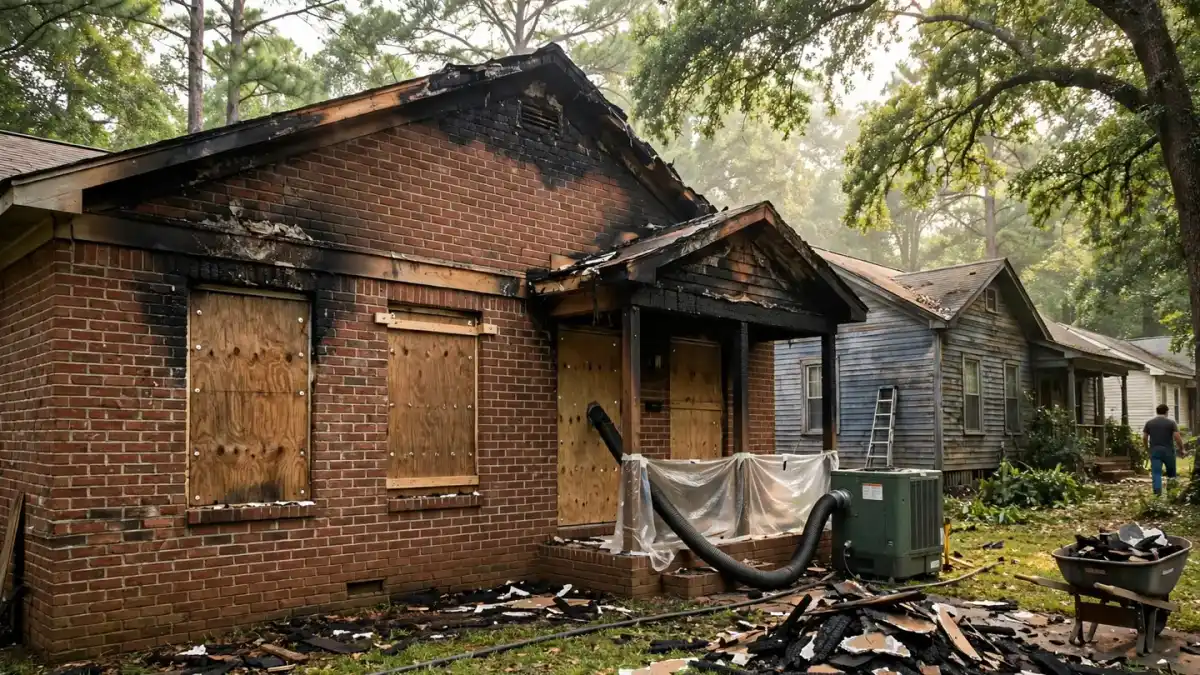
Tudor Revival houses in Myers Park have steep gables, cross gables and tall chimneys, and Colonial Revival homes add dormers and hipped sections [6]. Water can find its way into every valley and joint, so tarps need generous overlaps and careful placement where roof planes meet.
On very steep slopes, a lift may be safer than a ladder. The crew plans the tarp so water runs off over it, not underneath.
Securing a Myers Park house
A typical order for an older, larger home.
- 1
Release and utilities at the Myers Park home
The fire department releases the house and gas and power are checked.
- 2
Photograph roof, windows and doors
Record original details that will need matching repairs.
- 3
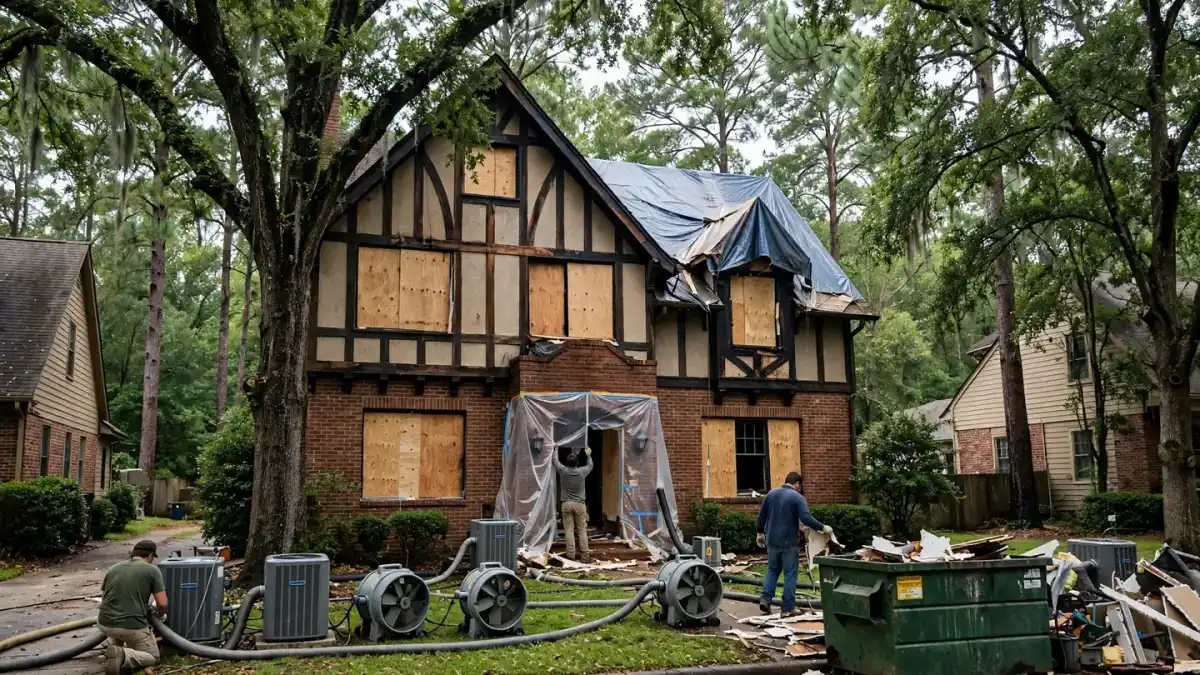
Cover windows without damaging frames
Panels sit in the masonry opening or casing, not through leaded sash.
- 4
Tarp slate or tile carefully
Work from ladders or lifts and secure the tarp at the damaged area.
Leaded glass and steel casement windows
Myers Park houses from the 1920s and 1930s often have leaded glass or steel casement windows. These are difficult to replace and often worth repairing. Board-up panels are fitted to the masonry opening and fastened to wood framing or bracing, not drilled into steel frames.
Broken leaded panels can be removed and stored for a glass restorer. Steel frames warped by heat are documented for repair or replacement.
Oaks and fallen limbs
Myers Park's tree canopy, especially the oaks along Queens Road, is one of its defining features [8]. A fire can scorch branches over a house, and weakened limbs may fall in later storms. Before roof work, crews check for hanging or damaged branches above the work area.
An arborist can assess heat-damaged trees. Removing dangerous limbs protects the tarp and the roof from further damage.
Storms and timing in Charlotte
Thunderstorms in summer and the remains of tropical systems in late summer and fall can bring heavy rain to Charlotte. Plaster ceilings, paneling and hardwood floors in large older homes are hard to restore once soaked, so roof covers should go on as soon as safely possible.
The National Weather Service office in Greer posts forecasts for the area [5]. Tarps should be checked after each storm.
Details to give about your Myers Park home
These help the crew plan.
- What covers the Myers Park roofSlate, clay tile, wood shake or asphalt.
- Kind of windows on the Myers Park houseLeaded glass, steel casements or wood double-hung.
- Trees over the houseLarge limbs near damaged areas.
- Historic district or landmark statusIf you know it.
Historic review in Myers Park
Myers Park appears on the National Register [7]. Parts may also fall within a local historic district, where exterior changes may need review. Temporary board-up after a fire is generally accepted, but permanent changes to windows, roofing or doors may need approval.
The Myers Park page lists agencies that may be involved.
Protecting fine interiors
Many Myers Park homes have paneled rooms, plaster moldings, antiques and art. After openings are covered, valuable contents should be moved away from wet or damaged areas, or covered with plastic.
Our firefighting water damage in Myers Park page explains drying large homes.
Records for your claim
Photos of each opening before and after board-up, receipts and dates help your adjuster. The North Carolina Department of Insurance provides guidance for homeowners on claims [1].
The what to do after a house fire guide lists other first steps.
Chimneys and copper details on Myers Park roofs
Tall brick chimneys, copper valleys and copper gutters are common on older Myers Park houses. A fire near a chimney can loosen flashing and crack the crown, and firefighters may have cut through gutters or flashing to reach the fire. These joints are where rain gets in first.
Temporary covers should lap over the loosened flashing so water runs off rather than behind it. Copper pieces that were bent but not burned are worth setting aside for the roofer, who can often reshape or reuse them.
FAQ
Board-Up and Tarping in Myers Park: questions
Can a slate roof in Myers Park be tarped without breaking more slate?
Yes, with roof ladders, hooks or lifts and careful tarp placement over the damaged area.
Will boarding up damage my leaded windows?
Panels fit the masonry opening and avoid the leaded sash, so the windows can be repaired.
Should an arborist look at trees after the fire?
If branches over the house were scorched, an arborist can check whether they are safe.
Sources and citations
- [1]North Carolina Department of Insurance
- [2]U.S. Fire Administration: Home fire prevention and safety
- [3]American Red Cross: Home fires
- [4]Mecklenburg County Code Enforcement
- [5]National Weather Service: Climate of Charlotte (GSP office)
- [6]Wikipedia: Myers Park (Charlotte)
- [7]North Carolina State Historic Preservation Office: Myers Park Historic District nomination
- [8]The Cultural Landscape Foundation: Myers Park