

Key facts: Soot Removal in Myers Park
Soot across Myers Park plaster ceilings
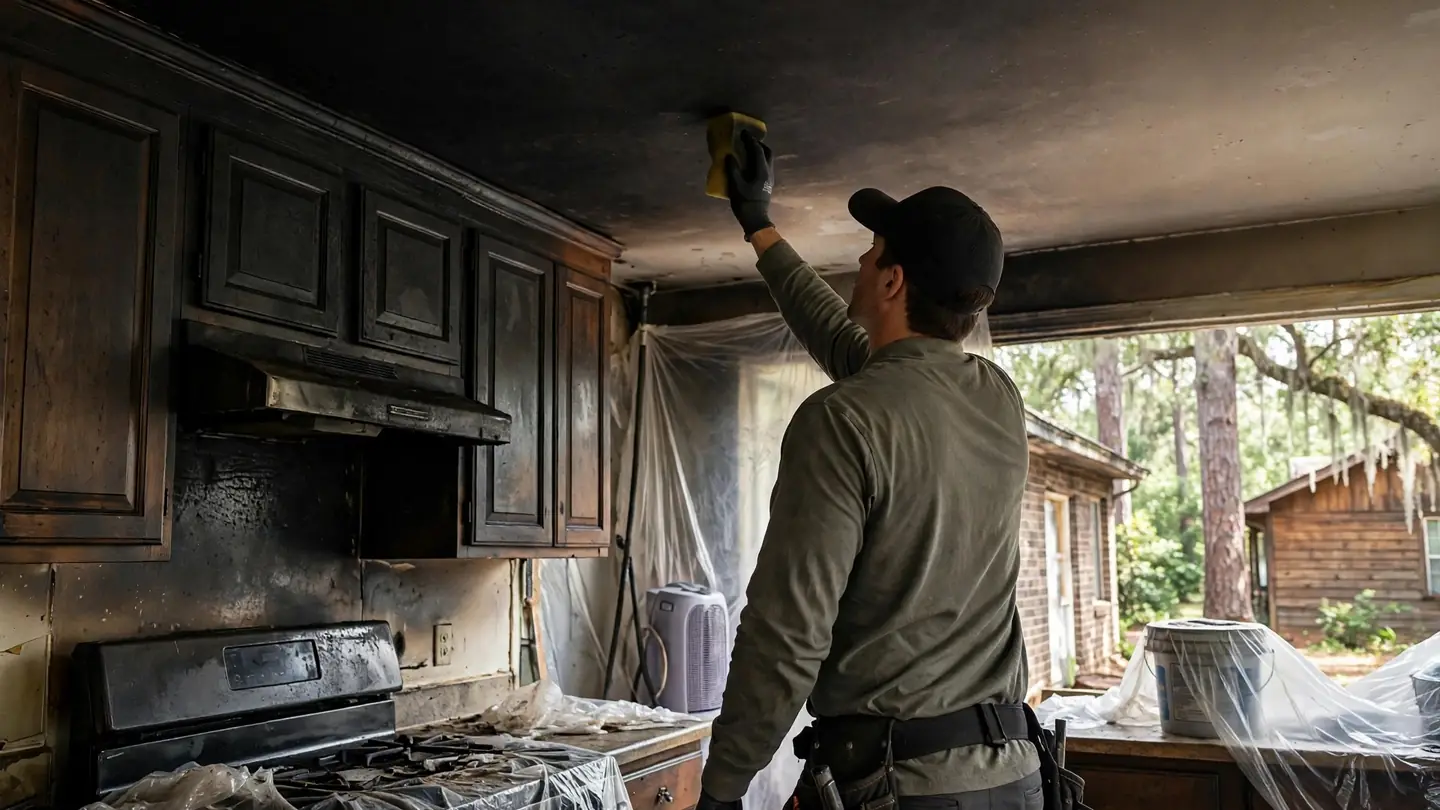
Plaster walls and ceilings are common in Myers Park's older homes. Soot sits on the surface and comes off with dry sponges and HEPA vacuums, then a gentle wash.
Ornamental plaster needs soft brushes and patience. A sealing primer covers faint marks.
Ceilings in larger Myers Park rooms are often nine feet or higher, and soot gathers most heavily near the top of walls and around the cornice. Crews clean from the top down, so residue that falls during cleaning lands on surfaces that have not been cleaned yet.
Soot in carved paneling and mantels
Soot on paneling and carved mantels gathers in grooves and details. Soft brushes and vacuums lift it before cleaning. Old finishes are tested first.
Damaged finishes may need refinishing by a specialist.
Carved details hold soot in every recess. Soft natural-bristle brushes and a HEPA vacuum with a brush tip reach these areas without scratching the finish, and cotton swabs are sometimes used on the finest carving.
Soot removal in a Myers Park room
A typical sequence.
- 1
Protect Myers Park floors and furnishings
Cover what stays in the room.
- 2
HEPA-vacuum Myers Park surfaces
HEPA vacuums remove surface soot.
- 3
Dry-sponge Myers Park plaster and paint
Lifts residue from plaster and paint.
- 4
Wash Myers Park finishes with tested cleaners
Matched to each finish.
Myers Park stone and brick fireplaces
Myers Park homes often have stone or brick fireplaces. Soot in rough masonry needs specialty cleaners and soft brushes.
Chimneys should be inspected after a fire.
Limestone and marble surrounds are softer than brick and stain more easily, so they need neutral stone cleaners rather than the stronger masonry products used on brick. A flue inspection makes sense even if the fire did not start at the fireplace.
Soot on Myers Park wide-plank floors
Old hardwood floors hold soot in their finish and gaps. Vacuuming and gentle cleaning often help. Heavier damage may need refinishing after a lead check [3].
Rugs should go to specialists.
Oriental and wool rugs that lay on these floors should be rolled and sent to a rug specialist, not vacuumed at home, since home vacuums can push soot deeper into the pile.
Asbestos checks before Myers Park soot work
Older homes may have asbestos in pipe wrap, tiles or duct insulation [5]. Surface cleaning does not usually disturb it, but removal can.
Test before removal.
Houses built in the 1910s to 1930s often have old boilers, steam pipes or duct runs in the basement wrapped in insulation that may contain asbestos. Soot on that wrap should be left alone until it is tested.
Breathing safely during Myers Park soot removal
Fine particles can reach deep into the lungs [2]. Crews use respirators and air scrubbers.
The U.S. Fire Administration advises waiting for the all-clear before reentering [4].
Large houses take longer to clean, so families sometimes want to stay in one part while crews work in another. That only makes sense if the work area is sealed with plastic and the air system serving the occupied rooms is clean and filtered.
Do and do not with soot in a Myers Park home
Simple steps while you wait.
- Leave Myers Park soot unwipedIt smears and sets.
- Keep Myers Park air systems offIt spreads soot.
- Move Myers Park art if it is safeIf safe to do so.
- Photograph every Myers Park roomFor your claim.
Silver, brass and hardware in Myers Park homes
Acidic soot can tarnish silver and brass quickly. Clean them soon.
Specialists can clean valuable metal pieces.
Door hardware, hinges, fireplace tools and light fittings made of brass or bronze also react to soot. Removing small hardware for cleaning is easier than working around it on the door.
How soot removal fits a Myers Park recovery
Soot removal follows board-up and drying. See board-up and tarping in Myers Park.
The Myers Park page explains local approvals.
Odor treatment follows soot removal, as our smoke odor removal in Myers Park page explains. The soot on walls and ceilings guide helps you recognize different residues.
Ghost marks and soot lines on Myers Park walls
After a fire, faint dark lines sometimes appear on plaster walls and ceilings, tracing the framing or lath behind them. These marks form where cooler surfaces draw soot out of the air. In older houses, lines can also follow cracks in the plaster where air moved through.
These lines usually lighten with dry sponges and cleaning, and a stain-blocking primer covers what remains. Where cracks are the cause, a plasterer can repair them before repainting so the lines do not return.
Soot on fabrics and upholstered antiques
Upholstered chairs, sofas and drapes in Myers Park homes are often old or made with delicate fabrics. Soot on fabric should never be rubbed. A HEPA vacuum with a soft brush, held just above the surface, lifts loose particles before any wet cleaning.
After that, textile specialists choose cleaning methods to suit each fabric. Silk and old wool need gentler handling than modern upholstery, and some pieces may need a conservator.
FAQ
Soot Removal in Myers Park: questions
Can soot be removed from my Myers Park plaster moldings?
Usually, with soft brushes, vacuums and gentle cleaning.
Should I clean my silver myself?
Prompt cleaning helps, but valuable pieces should go to a specialist.
Do wide-plank floors need refinishing after soot?
Not always. Light soot often cleans off.