Key facts: Smoke Odor Removal in Dilworth
- Dilworth's National Register district is known for bungalow, Colonial Revival and Period Revival houses [6].
- The EPA says portable air cleaners with suitable filters can reduce some indoor particles and gases [3].
- Volatile organic compounds from smoke and many household products can build up indoors, according to the EPA [4].
Hollow walls in older Dilworth houses
Many Dilworth houses built before the 1930s use balloon framing, where wall studs run from the foundation to the roof without fire blocking between floors. During a fire, smoke can travel up these channels from the first floor to the attic, leaving residue inside the walls.
Odor from those cavities can seep out through outlets, gaps in trim and cracks in plaster. Treating the rooms alone may not be enough. Contractors sometimes treat the cavities through small openings, or seal the inside of the walls when they are opened for other repairs.
Plaster, lath and odor
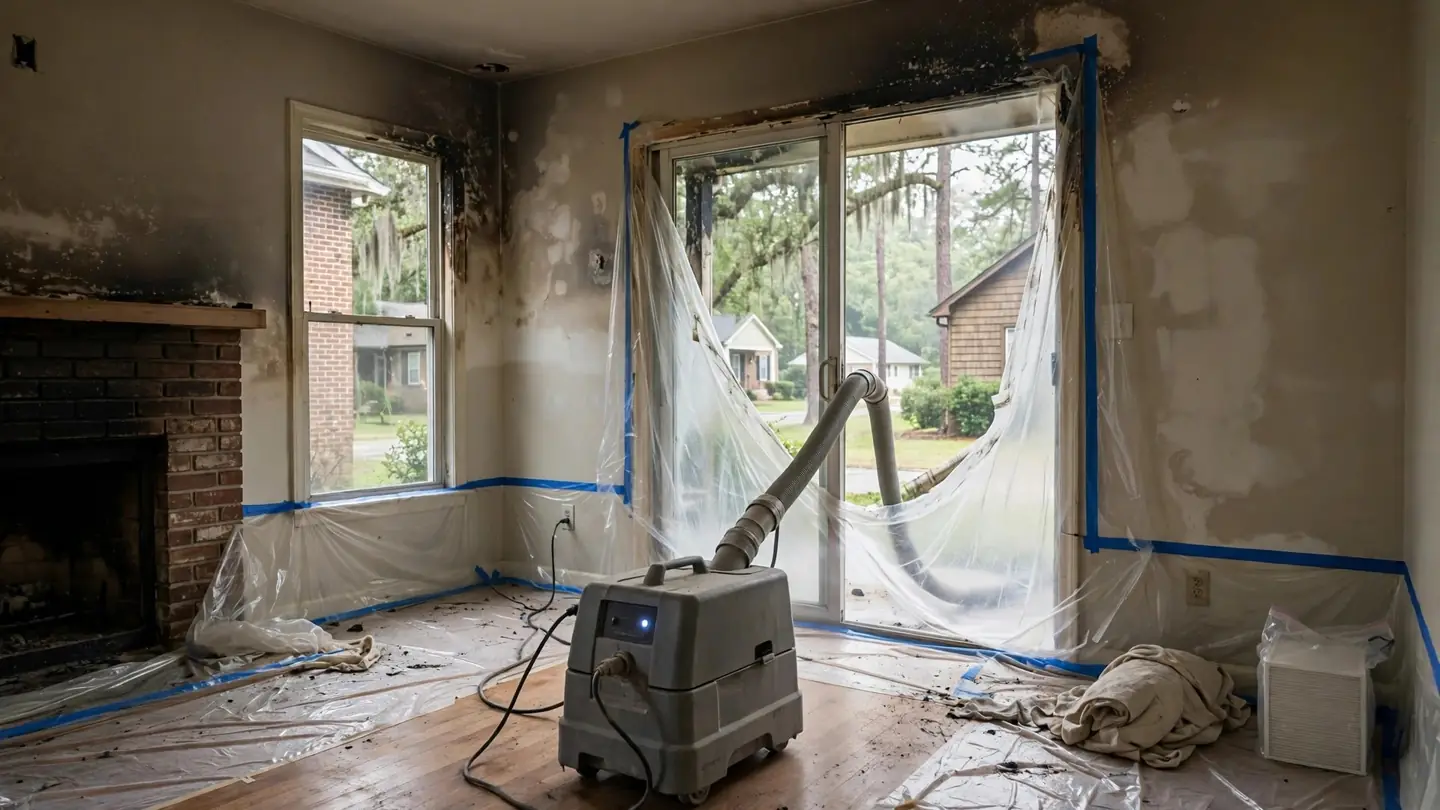
Dilworth walls and ceilings are often plaster on wood lath. Plaster's hard surface holds less smoke than drywall, but the wood lath behind it is porous and can keep odor for a long time. Fine cracks in old plaster let smoke reach the lath.
After cleaning the plaster surface, a sealing primer helps lock in faint residue. Where plaster has to be removed for other reasons, the exposed lath and framing can be cleaned and sealed before new finishes go on.
Odor work on a Dilworth house
A common sequence in older homes.
- 1
Clean residue throughout the Dilworth house
Plaster, trim, floors and fixtures are cleaned first.
- 2
Check the crawl space and attic
Look for smoke residue and moisture in both areas.
- 3
Address ducts and heating units
Clean or replace ducts that carried smoke.
- 4
Deodorize and seal the cleaned Dilworth rooms
Air filtration and sealing primers on cleaned surfaces.
Heart pine and oak floors
Original heart pine or oak floors are common in Dilworth. Smoke can work into the old finish and between boards, especially if the floor was also wet from firefighting. Cleaning the surface often helps, but strong odor may need the floors sanded and refinished.
Before sanding, old finishes and paint nearby should be checked for lead, since pre-1978 homes may contain it [7]. Our soot removal in Dilworth page explains how floors are cleaned before refinishing.
Crawl spaces and rising odor
Most Dilworth houses sit above a crawl space. Smoke and firefighting water can both reach it. A damp crawl space in Charlotte's humid climate can hold smoke odor and add a musty smell, and air from below rises into the house through gaps in the floor.
Drying the crawl space, removing damaged insulation and cleaning exposed framing all help. If ductwork runs through the crawl space, it should be inspected too.
Older heating and cooling systems
Dilworth homes have a mix of systems, from ducts added under the floor or in the attic to newer ductless units. Any system that ran during the fire may hold smoke. Old ducts with lining or wrap can be hard to clean and may be replaced instead.
Duct insulation and wrap in older houses can contain asbestos, so it should be tested before it is removed [8]. Change filters before running the system again.
Why ozone needs care in an older home
Ozone generators are sometimes used for smoke smell. The EPA warns that ozone harms the lungs and that these machines may not remove odor sources well [1]. Ozone can also affect rubber, some fabrics and old finishes.
Air scrubbers with carbon filters and careful cleaning are gentler options [5]. The smoke odor that won't go away guide explains how to track hidden sources.
Fabrics, rugs and furnishings
Curtains, upholstery and rugs absorb smoke. Many can be cleaned with methods designed for smoke, while heavily affected pieces may not recover. Antique items should go to cleaners who handle older fabrics and finishes.
Keep cleaned items away from the house until odor work is complete, so they do not pick up smoke again.
Linking odor work to the full recovery
Odor treatment comes after the house is secured, dried and cleaned. The Dilworth page explains how older materials affect each step and which approvals may apply.
Good ventilation during odor work helps clear chemical smells from cleaning products and paint [4]. Ask your contractor which products they plan to use.
FAQ
Smoke Odor Removal in Dilworth: questions
Why does my Dilworth house still smell after the walls were cleaned?
Smoke may be inside hollow walls, the wood lath or the crawl space. Those sources need their own treatment.
Do my heart pine floors need refinishing?
Not always. Cleaning may be enough for light smoke, but strong odor or water damage often calls for refinishing.
Is ozone safe for my older home?
The EPA warns ozone harms lungs, and it can affect old finishes. Use it only in an empty house, if at all.
Sources and citations
- [1]U.S. EPA: Ozone generators that are sold as air cleaners
- [2]U.S. Fire Administration: Home fire prevention and safety
- [3]U.S. EPA: Guide to air cleaners in the home
- [4]U.S. EPA: Volatile organic compounds' impact on indoor air quality
- [5]Wikipedia: Activated carbon
- [6]North Carolina State Historic Preservation Office: Dilworth Historic District nomination
- [7]U.S. EPA: Lead renovation, repair and painting program
- [8]U.S. EPA: Protect your family from asbestos