
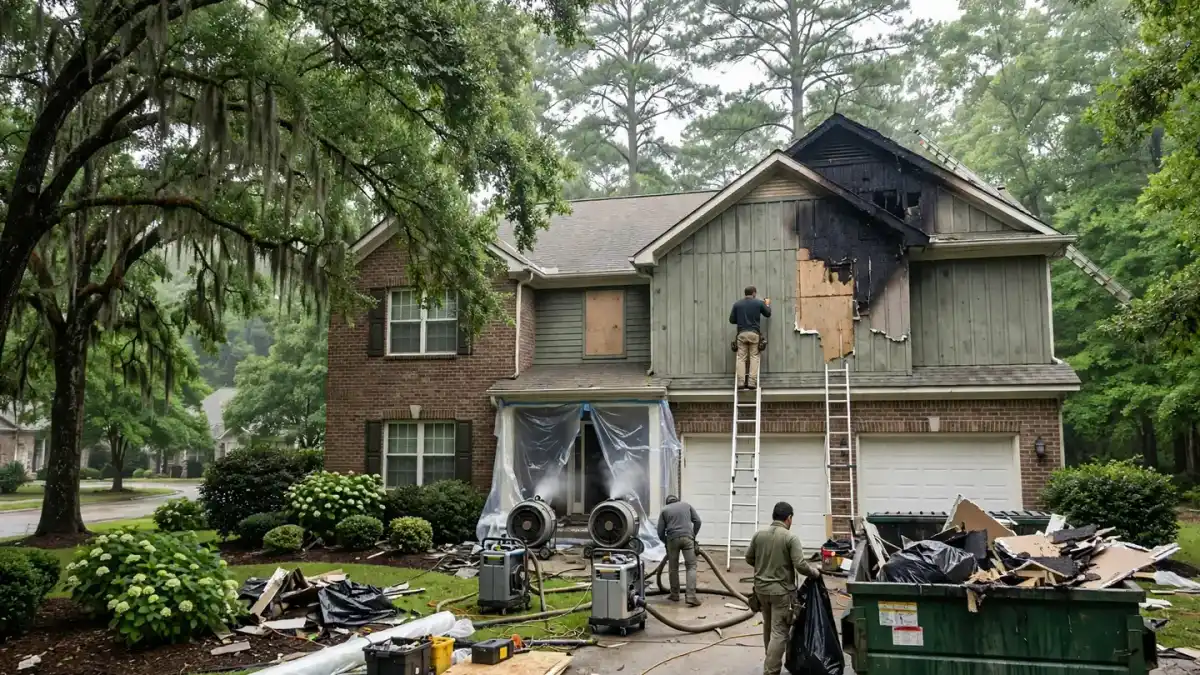
Key facts: Firefighting Water Damage in Ballantyne
- The EPA advises drying water-damaged materials within 24 to 48 hours to help prevent mold growth [1].
- CDC guidance says items that cannot be cleaned and dried should be thrown away after flooding or water damage [3].
- Wood I-joists, common in newer houses, can lose strength faster in fire than solid lumber [7].
Where water goes in a Ballantyne two-story
Most Ballantyne houses have two full floors, with I-joists or floor trusses between them [6]. Water from a second-floor fire soaks the carpet and pad, then runs through the subfloor into the open spaces between joists. It collects in the drywall ceiling below until it drips or the ceiling sags.
A sagging ceiling can hold a lot of water and may come down suddenly. Nobody should stand under it. Crews make small drain holes or remove the wet section under control, then start drying the floor cavity.
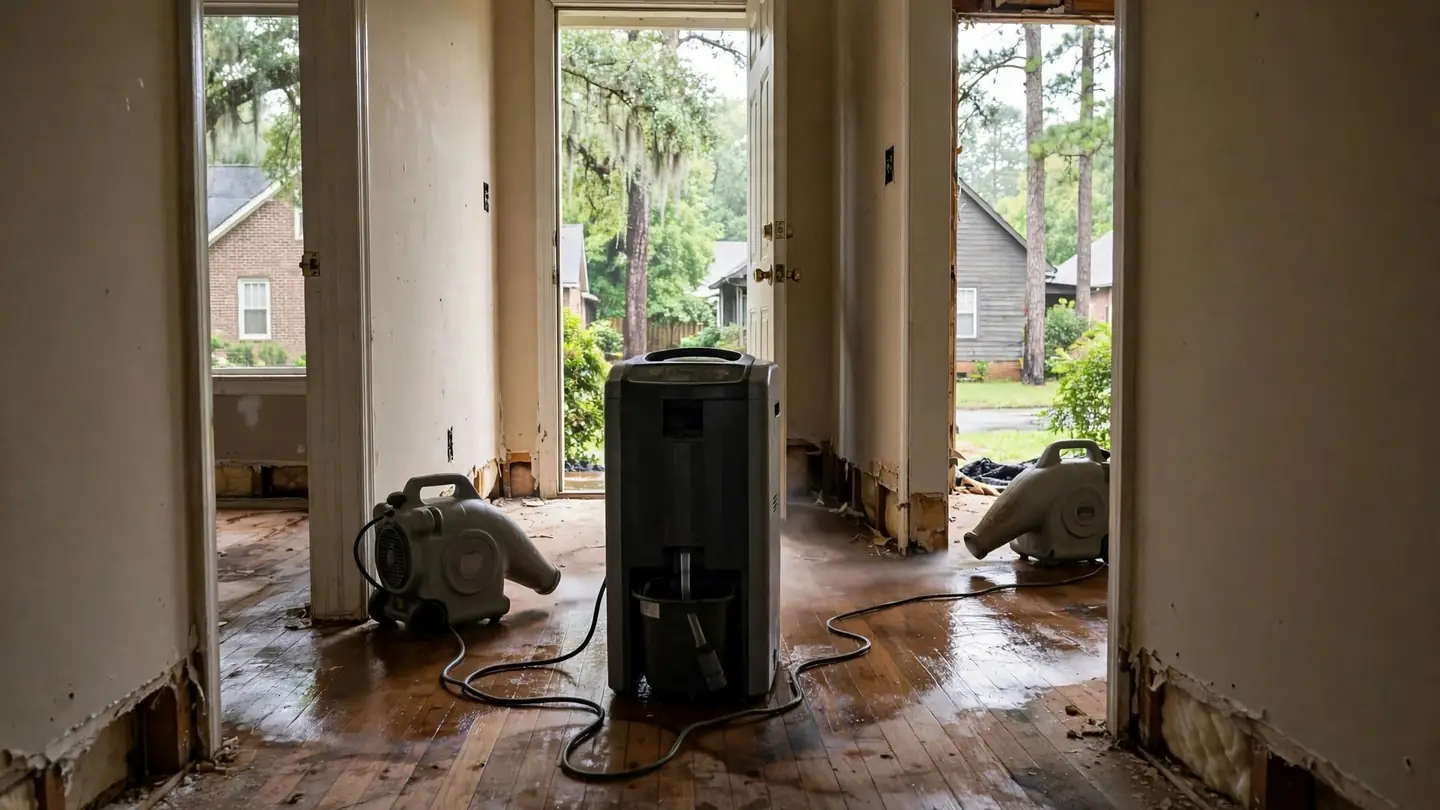
Engineered joists and wet subfloors
Floors in newer homes are often built with I-joists and oriented strand board subfloor. Both are wood products held together with glue, and both can swell when they stay wet. Heat from the fire may already have weakened joists near the origin [7].
Drying the floor cavity from below, with fans and dehumidifiers, protects the framing. Joists that are charred, delaminated or soft should be checked by someone qualified to judge structure before new floors go down.
Drying sequence in a Ballantyne home
What usually happens in the first days.
- 1
Make the Ballantyne house safe
Power is checked, sagging ceilings are relieved and slippery areas marked.
- 2
Pull standing water from Ballantyne floors
Pumps and extraction tools pull water from carpet and floors.
- 3
Open wet cavities
Wet pad, baseboards and lower drywall come out so air can reach inside.
- 4
Dry and measure daily
Fans and dehumidifiers run while moisture readings track progress.
Charlotte humidity and drying times
Summer air in the Charlotte area is often hot and very humid. Opening windows on those days can bring more moisture in than it takes out. Drying a house after firefighting usually works better with the windows closed and dehumidifiers running.
The EPA recommends drying wet materials within a day or two to limit mold [1]. In muggy weather, that target is hard to meet without equipment, so getting drying started early makes a real difference.
Carpet, pad and engineered floors
Upstairs carpet that took firefighting water is often a loss, mainly because the pad underneath holds water and smoke. Carpet on the main floor may sometimes be dried in place if it was only damp and the water was clean, but water used on a fire carries soot and debris.
Engineered hardwood and laminate on the main floor react quickly to water. Their cores can swell within hours. Boards that have cupped or lifted usually need replacement, and the subfloor beneath them must be dry first.
Drywall, insulation and wall cavities
Wet drywall loses strength and can grow mold on its paper face. In most cases the bottom section of wet walls is removed, along with wet insulation, so the framing can dry. Upper portions that stayed dry can remain.
Exterior walls in Ballantyne homes have insulation and sheathing that hold water. Moisture meters show which sections are still wet. Rebuilding should not start until readings show the wood has dried.
Warning signs after water use in a Ballantyne house
Point these out to your contractor.
- Ceiling bulges below a bathroom or bedroomWater may be trapped above.
- Soft spots in upstairs floorsSubfloor or joists may be damaged.
- Musty smell after a few daysMold may be starting.
- Water in the crawl space or garageIt may have drained down from above.
Electrical safety with wet areas
Water and electricity do not mix. Before anyone walks through wet rooms, power to those areas should be shut off and checked. The U.S. Fire Administration advises letting qualified people inspect electrical systems after a fire [2].
Outlets, switches and fixtures that were soaked should be inspected and may need replacement. Permits for electrical repair in Charlotte come from Mecklenburg County Code Enforcement [4].
Contents that got wet
Furniture, rugs, papers and clothing can all be soaked during firefighting. CDC guidance says porous items that cannot be cleaned and dried quickly should be discarded [3]. Hard furniture can often be cleaned and dried, while mattresses and upholstered pieces that were soaked usually cannot be restored.
Photographs, documents and books can sometimes be frozen to stop damage until they are dried by a specialist. Separate them early and keep them cool.
Where water drying fits in
Drying normally starts right after the house is secured with board-up and tarping. Once the structure is dry, smoke damage cleanup can proceed without trapping moisture behind new paint.
The Ballantyne page outlines the usual recovery stages, from the first days of drying to the final rebuild.
FAQ
Firefighting Water Damage in Ballantyne: questions
My Ballantyne ceiling is sagging with water. What should I do?
Stay out from under it and let a crew drain or remove it. A water-filled ceiling can fall without warning.
Can I open the windows to help dry my house?
On humid Charlotte days, open windows can add moisture. Closed windows with dehumidifiers usually dry faster.
Does wet carpet upstairs always need replacing?
Often, because the pad holds water and soot from firefighting. A contractor can check whether any can be saved.